Sunday, May 26, 2019

Week 8: NanoTech + Art

Week 8: NanoTech + Art

In this week’s lecture, we learned that Nanotechnology is influencing nearly every aspect of our lives. For instance, it can be applied in agriculture, food production, and medicine. Notably, in the reading of “The Nanomeme Syndrome: Blurring of fact & fiction in the construction of new science,” I learned that Nanotechnology is “ultimately about a shift in our perception of reality from purely visual culture to one based on sensing and connectivity” (Gimzewski and Vesna).

An example of nanotechnology shirting our perception is the invention of the Scanning Tunneling Microscope, a symbol of the shift from visual to tactile perception, as mentioned in the reading. The scanning tunneling microscope works by scanning a very sharp metal wire tip over a surface. We can image the surface at a microscopic scale, down to resolving individual atoms.

Quantum Corral created with STM
https://slideplayer.com/slide/3866674/

I also really like the idea that nanoscale science and media art are perfect examples of the new third culture we mentioned in the first week, embracing biologically inspired shifts, unique aesthetics, and definitions. So I explored the John Curtin Gallery to learn more about art in the age of nanotechnology.

In the gallery, I learned that there are more examples that illustrate a shift in our perception of reality from visual culture to one based on sensing. For instance, the project created by Christa Sommerer and Laurent Mignonneau, Nano-Scape, tries to make the nano-world accessible through touch. In the picture below, a wireless magnetic force-feedback interface allows users to touch nanoparticles, creating an ever-changing invisible sculpture (Sommerer and Mignonneau 2005).

Nanoscape 

http://www.interface.ufg.ac.at/christa-laurent/WORKS/FRAMES/TOPFRAMES/NanoScapeTop.html

An other example is a project created by our Professors Victoria Vesna and James Gimszewkski. Nanomandala consists of a 15-minute video projected onto a disk of sand, 8 feet in diameter. Visitors touch the sand as oscillating images of the molecular structure of a single grain of sand obtained via a scanning electron microscope. These images are projected to reveal the recognizable image of the entire mandala, and then back again.
Nanomandala
http://nano.arts.ucla.edu/mandala/mandala.php
Nanomandala by Professor Vesna

References:
“John Curtin Gallery.” Art.Base, art.base.co/event/2104-art-in-the-age-of-nanotechnology#11.

Mignonneau, Laurent, and Christa Sommerer. “Nano-Scape.” Proceedings of the 2005 ACM SIGCHI International Conference on Advances in Computer Entertainment Technology - ACE 05, 2005, doi:10.1145/1178477.1178507.

“Nanomandala.” NANO, nano.arts.ucla.edu/mandala/mandala.php.

“Scanning Tunneling Microscopy.” Nanoscience Instruments, www.nanoscience.com/techniques/scanning-tunneling-microscopy/

Vesna, Victoria, and Jim Gimzewski . “The Nanomeme Syndrome: Blurring of Fact & Fiction in the Construction of a New Science.” vv.arts.ucla.edu/publications/publications/02-03/JV_nano/JV_nano_artF5VG.htm.


Saturday, May 25, 2019

Event 2: Exploratorium

Event 2: Exploratorium

For this event, I went to the Exploratorium in SF. It is one of the most fun museums that I have ever been to. Especially, it helped me get a better understanding of how art helps us to understand biology and neuroscience.
Map of Exploratorium

For instance, in the lecture of neuroscience, we learned about Franz Joseph Gall, and his introduction of phrenology, which is based on the idea that parts of the brain are associated with different traits and skills(Vesna). However, our brain can also get confused easily. For instance, in this picture, the hot-cold coils teach us that our brains can combine conflicting sensations to jump to a startling conclusion. When I grabbed the center coils with my palm, I felt the coils were painfully hot, but when I touch the center coils one at a time with my fingertip, I found that they actually alternate between warm and cold. This design illustrates an illusion, which is called the thermal grill illusion. Today, neurobiologist study it to understand the usually “phantom” pains experienced by amputees and stroke victims.
Picture I took from exploratorium: the hot-cold coils

I also found it fascinating about how arts such as paintings can be viewed differently through some biological effects such as binocular rivalry. In this picture, when I centered my nose on the pink stripe at the edge of the mirror and looked straight ahead with both eyes open, I saw the images were alternating. I learned that when our brains get strongly conflicting information from two eyes, it usually turns off the information from one eye.
Me and the binocular rivalry

I would recommend this event because it is exciting to experience the designs they have. It would benefit my classmate because it is a really interactive and creative place. We can learn science not by reading a textbook, but by doing the experiments following the instruction on the designs and experiencing the effect with senses such as touch, sound, and sight. Then, we can read the simple explanations of the designs to understand the effects. Here are more pictures of the interesting exhibit to experience and learn.
We can learn how color affect our emotion from this exhibit


For instance, in the picture above, a boy is talking to the computer. It remained me of the lecture we learned about Alan Turing and artificial intelligence with robotics. 

ticket I bought

Reference: 
Vesna, Victoria. “Neuroscience-pt1.Mov.”  YouTube, 17 May 2012, www.youtube.com/watch?time_continue=267&v=TzXjNbKDkYI.


Sunday, May 19, 2019

Week 7 Neuroscience +Art

Week 7 Neuroscience +Art
This week, we learned more about the interaction between art and science, specifically neuroscience. In the reading of “Neuroculture,” Giovanni Frazetto and Suzanne Anker summarized that neuroscience is not solely constrained within laboratories, but readily captures the attention of the public at large. Neuroscience portrayed in literature, film, works of art, the mass media and commercial product offers an opportunity to make the scientific community and the public aware of the social and ethical implications of the scientific advances in neuroscience (Frazzetto & Anker 2009).
                   
A great example of an artist combining art and science to contribute to the idea of consciousness in neuroscience is Ramón y Cajal, who was awarded the Nobel Prize for medicine and physiology. As the father of modern neuroscience, he described pyramidal cells, neurons that he discovered as these butterflied of the soul. Here is one of his painting of neuronal network.
Santiago Ramón y Cajal Drawings
Another example of combining art and science is Brainbow, a visualization tool which is particularly useful in the study of dynamic biological systems. Brainbow is a genetic cell-labeling technique where hundreds of different hues can be generated by stochastic and combinatorial expression of a few spectrally distinct fluorescent proteins. From 3 to ∼100 colors can be generated by Brainbow (Weissman, Tamily & Pan 2015)

Imagine this: A team of 15 neuroscientists is to get R900-million in start-up funding for a project that could find a cure for diseases such as Alzheimer's, as well as a range of mental disorders. (Harvard University)https://bhekisisa.org/article/2013-06-28-00-theres-gold-at-the-end-of-the-brainbow

We also discuss the idea of consciousness and unconsciousness. So I read the Global Consciousness Project (GCP), which is an international effort involving researchers from several institutions and countries, designed to explore whether the construct of interconnected consciousness can be scientifically validated through objective measurement. The project demonstrated that human consciousness interacts with random event generators (REGs), apparently causing them to produce non-random patterns. Here is a YouTube video about the project.

The Global Consciousness Project - Ph.D. Roger Nelson

However, while I believed that scientific breakthrough is mostly beneficial to the humankind, it is also fascinating to learn the perspective of Carl Jung, who thought that the industrial revolution also played a significant role in the emergence of the spiritual problem. He believed that methods of science could be used to remodel society, which can result in an increase in uniformity and a drastic decrease in the importance of the individual (Jung 1928).


References: 


“Carl Jung and the Spiritual Problem of the Modern Individual.” Academy of Ideas, 1 Jan. 2019, academyofideas.com/2017/06/carl-jung-spiritual-problem-modern-individual/.

Frazzetto, Giovanni, and Suzanne Anker. “Neuroculture.” Nature News, Nature Publishing Group, 1 Nov. 2009, www.nature.com/articles/nrn2736.

Nelson, Roger. “Global Consciousness Project: Introduction.” Princeton University, The Trustees of Princeton University, noosphere.princeton.edu/gcpintro.html.

Vesna, Victoria. “Neuroscience (Part 1).” Lecture. 19 May 2019

Weissman, Tamily A, and Y Albert Pan. “Brainbow: New Resources and Emerging Biological Applications for Multicolor Genetic Labeling and Analysis.” Genetics, Genetics Society of America, Feb. 2015, www.ncbi.nlm.nih.gov/pmc/articles/PMC4317644/.

Sunday, May 12, 2019

Week 6 BioTech+Art

Week 6 BioTech+Art
Life itself is a valid expressive medium for me because life expresses the diversity among and within different species. The meaning inherent in the use of transgenics, mutilation, mutation, recombinance or selective breeding as an artistic technique is based on this belief. As Professor Vensa mentioned in the lecture, Eduardo Katz considered these modifications of life as an expansion of the present practical and conceptual boundaries of artmaking to incorporate life invention (Kac 2000).
GFP Bunny
http://www.artnexus.com/Notice_View.aspx?DocumentID=19376
Although artistic media and technologies have created some controversies, the value they have brought are enormous. As Ellen K. Levy mentioned in the reading of “Defining Life: Artists Challenge Conventional Classifications,” art can challenge the status quo in a longer-lasting way through provoking consideration of the limitations and legal ramifications(Levy 2011). For instance, artists have explored some of the conditions that define life and its implications for legal rights and property. In 1980 U.S. Supreme Court decision that determined that genetically engineered microorganisms are patentable. The case of Chakrabarty v. Diamond allowed Chakrabarty to manufacture his oil-eating bacterium and extended the definition of what is considered patentable to living organisms that have been genetically altered (Levy 2011).
A new group of oil-eating bacteria have been discovered in the Mariana Trench
https://newatlas.com/oil-eating-bacteria-mariana-trench/59279/
As a student major in biochemistry, I am fascinated by the role artists had played in the journey of scientific revolutions. In the reading of “meanings of participation: Outlaw Biology?” Chris Kelty mentioned the creativity of Outlaws, Hackers, Victorian Gentlemen breeds creativity (Kelty 2010). Artists working in biomedia and artificial life really led to more innovations. For instance, the "GFP Bunny" created by Eduardo Kac, had lead to development of “transgenic art,” which can contribute to the field of aesthetics by “opening up the new symbolic and pragmatic dimension of art as the literal creation of and responsibility for life” (Kac 2000).
The blood-brain barrier in a live zebrafish embryo
https://www.nikonsmallworld.com/galleries/2012-photomicrography-competition/the-blood-brain-barrier-in-a-live-zebrafish-embryo
The controversies that have been raised by biotechnology are pieces of evidence that biotech is inherently different from how other technologies are evaluated. As it is mentioned by Levy, “Biotechnology is a place where political, economic, legal, and scientific interests meet, and artists can promote discussion about these issues.”
As to the question, “should the restrictions be more or less stringent for artists using biotechnology than for scientists in industry/academia?’ I believe that there should be equally stringent with sufficient training and peer oversight, adequate regulation, and professional controls. Ultimately, I believe that human creativity should be restricted by ethics and risks.

References:
Diamond v. Chakrabarty, digital-law-online.info/cases/206PQ193.htm.
Levy, Ellen. “Defining Life: Artists Challenge Conventional Classifications.”Context Providers: Conditions of Meaning in Media Arts. Eds. Margot Lovejoy, Christiane Paul, and Victoria Vesna. University of Chicago Press: 2011.
C.M. Kelty, Outlaw, hackers, victorian amateurs: diagnosing public participation in the life sciences today, Jcom 09(01) (2010) C03
Kac, Eduardo. GFP BUNNY, www.ekac.org/gfpbunny.html#gfpbunnyanchor. 2000
Vesna, Victoria, narr. “BioTech Art Lectures I-V.” N.p., . web. 12 May 2019.


Sunday, April 28, 2019

Week 4: MedTech + Art


As a student majoring in biochemistry, I never relate art and science when I studied the human genome project and the human microbiome project. It is exciting to hear that medicine was considered art in the twentieth century. In the article “The Architecture of Life,” Ingber mentioned, “my studies of cell biology and also of sculpture led me to realize that the question of how living things form has less to do with chemical composition than with architecture (Ingber 1998).” So I paid attention to the models and sculpture in the reading, and I found they illustrate the intersection of art, design, and science.    

           
Tensegrity I. Cell structure and hierarchical systems biology mentioned in the reading
 
http://jcs.biologists.org/content/116/7/1157.figures-only
The reading “Magnetic Resonance Imaging (MRI) as Mirror and Portrait: MRI Configurations Between Science and Arts” gives me new perspectives on what MRI is like. Before reading about this essay, I thought doctors merely focus on the images of MRI and tried to determine if there are any abnormalities. However, this essay argues the look of MRI is acoustic more than visual because it is based on the aural components of the examination, rather than on MRI images alone. More importantly, Casini argued that MRI has the capacity of being performatives because MRI images have become a portrait in so far as they can look back at the viewer (Casini 2011)
MRI Scans Can Detect Early Onset of Parkinson's http://time.com/2860630/mri-scans-can-detect-early-onset-of-parkinsons-study-finds/
It is fascinating to learn about how artists, like Eduardo Katz, Stelarc and Kevin Warwick tested the technology on their bodies and contribute to the advancement of medicine. For instance, Diane Gromala used visual reality used to relieve chronic pain In the lecture. Professor Vesna mentioned that Kevin instigated a series of pioneering experiments involving the neuro-surgical implantation of a device into the median nerves of his left arm to link his nervous system directly to a computer to assess the latest technology for use with the disabled. Some of Kevin’s recent research involves a collaborative project with the Oxford neurosurgeon, Prof. Tipu Aziz, using intelligent computer methods to predict the onset of Parkinsonian tremors such that they can be stopped using a deep brain implant. His implants are on display in the Science Museums in London and Naples and continue to serve as a model of advancement in biomedical engineering.

Professor Kevin Warwick has blurred the boundaries between men and machine
https://www.thetimes.co.uk/article/tiny-microchip-implanted-in-the-brain-could-turn-us-into-mind-readers-5pz5tx26k97

Sources


Casini, Silvia. “Magnetic Resonance Imaging (MRI) as Mirror and Portrait: MRI Configurations Between Science and Arts.” 2011
Gromala, Diane, perf. Curative Powers of Wet, Raw Beauty. 2011. Video. 28. Apr 2019.<http://www.youtube.com/watch?feature=player_embedded&v=cRdarMz–Pw>.
Ingber, Donald E. “The Architecture of Life.” Scientific American, vol. 278, no. 1, 1998, pp. 48–57., doi:10.1038/scientificamerican0198-48.
Kevin Warwick, www.kevinwarwick.com/.
Vesna, Victoria. “Medicine Parts 1-1.” Lecture. Web. 28. Apr 2019.
Vesna, Victoria. “Medicine Parts 1-3.” Lecture. Web. 28. Apr 2019.


Wednesday, April 24, 2019

Event 1: Aaron Marcus: Early Works

I went to the event of Aaron Marcus: Early Works at the Berkeley Art Museum and Pacific Film Archive (BAMPFA). There, I saw some great artworks that illustrate the “Third Culture,” which bridges between science and art.

In this event, I saw the works of two artists. The first artist is Aaron Marcus. Educated in physics, mathematics, and philosophy at Princeton University and trained in graphic design at Yale, Aaron Marcus explores new possibilities for expression. He created his first “computer-assisted poem-drawings” in the spring of 1972. His artworks also illustrate the theme of art + robotics. Marcus experimented with a photo-typesetting machine connected to a digital computer, reordering the symbols and their uses to create new meanings.

It is the first time for me to see “computer-assisted poem-drawings,” a phrase that I have never heard of before. In these drawings, I saw his creativity with new visual representations of words.
picture I took
For instance, this painting is named “gravity.” In this static drawing, I can feel a sense of motion. Looking from top to bottom, I can imagine that due to gravity, the lines are falling, filling up the empty squares and circle. Therefore, at the bottom, the squares and the circles are filled, and fewer vertical lines are shown.
Aaron Marcus: Evolving Gravity, 1972–74; serigraph; 29 1/2 x 22 in.; BAMPFA, gift of the artist
 bhttps://bampfa.org/program/aaron-marcus-early-works.
This drawing is fascinating to me too. At first glance, I can see three colors in it: red, yellow and orange.  As I looked more carefully, I found out that the painting is full of letters “H” in yellow, and the color of the background is consistent. I never thought of changing the spacing between letters can create a sense of color transition. In these artworks, Marcus makes connections between art, science, design, and visual poetry.

Shades of Hades, Aaron Marcus, 1972–74, Lithograph, 11 x 8 1/2 in., Gift of the artist, 2018.57.6
http://collections.vam.ac.uk/item/O555956/shades-of-hades-print-marcus-aaron/
Besides the benefits of seeing these fascinating paintings I mentioned above, I would recommend this event because it made me I realized a new definition of "art" and how technology has helped to create art much more easily. After looking at the artworks of Aaron Marcus, I saw the works of the second artists, who is also the pioneer of computer-assisted drawing, Frederick Hammersley.  Here is the wall of his computer-assisted drawings.
Picture I took
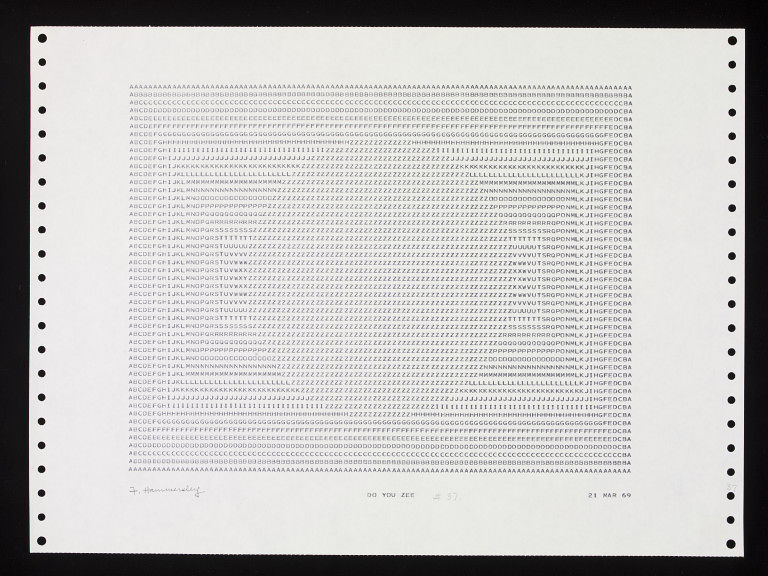
A unique painting that I paid attention to is this. It is named “Do you Zee.” I took a closer look into the painting, and I found out it is just a simple alignment of the 26 English alphabets. However, the number 37 is hidden in the pattern of these letters. 
Selfie with sticker given by museum
Before this event, I always thought that the creation of art is a challenging task for me, and I do not consider myself as someone who has the potential to be an artist. However, these computer-assisted drawings helps me with my midterms and final for this class by giving me a sense of confidence that art creation can be simple; drawings can just consist of letters, without colors. Moreover, everyone can be an artist, not only people with the talent to draw beautifully. I think after seeing computer-assisted paintings like these, my classmates who are not convinced that they too, can be artists, will be more confident in their artistic ability. Hopefully, they can be inspired to create their computer-assisted artworks with their imagination and whimsy.

Me and staff at BAMPFA  


Reference

“Aaron Marcus: Early Works.” BAMPFA, bampfa.org/program/aaron-marcus-early-works.


Sunday, April 21, 2019


Week 3 Robotics + Art 


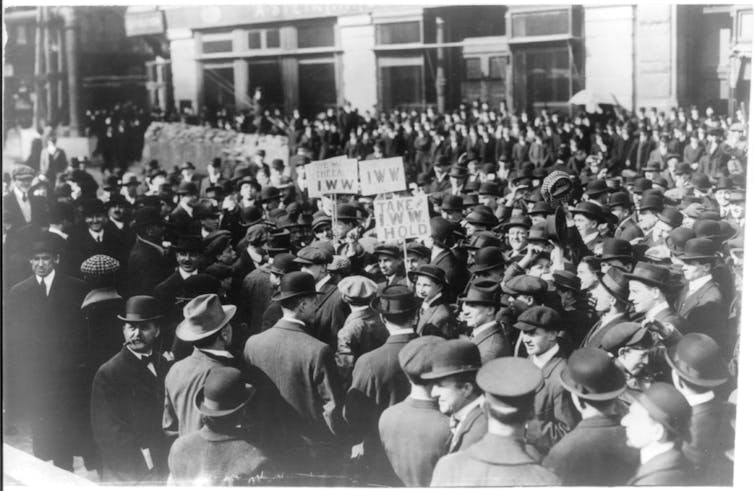
Upheaval more than a century into the Industrial Revolution, and more than 100 years ago: An International Workers of the World union demonstration in New York City in 1914
https://theconversation.com/what-the-industrial-revolution-really-tells-us-about-the-future-of-automation-and-work-82051
In the reading of “The Work of Art in the Age of Mechanical Reproduction,” Benjamin analyzed how mechanical reproduction destroys the idea of uniqueness and tradition, as Professor Vesna mentioned in her lecture. He argued, “The total function of art is reversed. Instead of being based on ritual, it begins to be based on another practice -- politics.” In the epilogue, he also inferred his thought about industrialization,” the horrible feature of imperialistic warfare are attributable to the discrepancy between the tremendous means of production and their inadequate utilization in the process of production to unemployment and lack of market” (Benjamin 1936).

On the other hand, in the reading of “The word of Art in the Age of Digital Reproduction,” Douglas Davis has a different perspective. In the reading, he argued that the work of art in the age of digital reproduction is trying to tell us that “each fragment, each image, each sound is unique, personal, quivering with the sense of self.” He valued the Internet as a platform where artists can interact with each other, new mode of thinking, art-making and deep personal touching can occur.  
place 1
One Million Internet Users Created This Piece of Art
https://www.smithsonianmag.com/smart-news/one-million-internet-users-created-piece-art-180962867/
Ex Machina Poster
https://www.imdb.com/title/tt0470752/
I think these two readings represent a general trend of our view on industrialization today. It is full of conflicts between benefits and social risks. For instance, our attitudes on artificial intelligence with robotics are conflicted and different based on different cultures. On the one hand, we have a promising view of the convenience and benefits AI can bring us. For instance, in the automobile industry, autonomous vehicles driven by AI provide mobility to people with disability.

On the other hand, we are afraid of the social risks posed by an AI and robotics, such as unemployment and even threatening the life of humans. In the movie Ex Machina, Ava, the humanoid robot with AI, killed Nathan, her owner, by deceiving his friend Caleb, and left Caleb trapped in an isolated building. The movie portrays robotics as evil and deceitful. This theme is contrasted with the Japanese culture and their views on robotics as friends to humans, as mentioned by Professor Kusahara.  It is fascinating for me to learn about how different cultures respond to industrialization and robotics differently based on their histories which influence their perspective of weighing risks and benefits.


References:

Benjamin, Walter. The Work of Art in the Age of Mechanical Reproduction. London: Penguin, 2008. Print.
Davis, Douglas. “The Work of Art in the Age of Digital Reproduction.” The MIT Press, 1995. Web. 19 Oct. 2012.
Dupzyk, Kevin. “Rewatch: Why 'Ex Machina' Is Even Scarier Four Years Later.” Popular Mechanics, Popular Mechanics, 16 Jan. 2019, www.popularmechanics.com/culture/movies/a25749315/ex-machina-double-take-data-harvesting/.
Vesna, Victoria  “Robotics.” Lecture 1.
Vesna, Victoria and Machiko Kusahara. “Robotics.” Lecture 4.

Extra Credit Event 4

For event 4, I went to the Lawrence Hall of Science, l ocated in the hills above the UC Berkeley campus, with a spectacular 180-degree view...